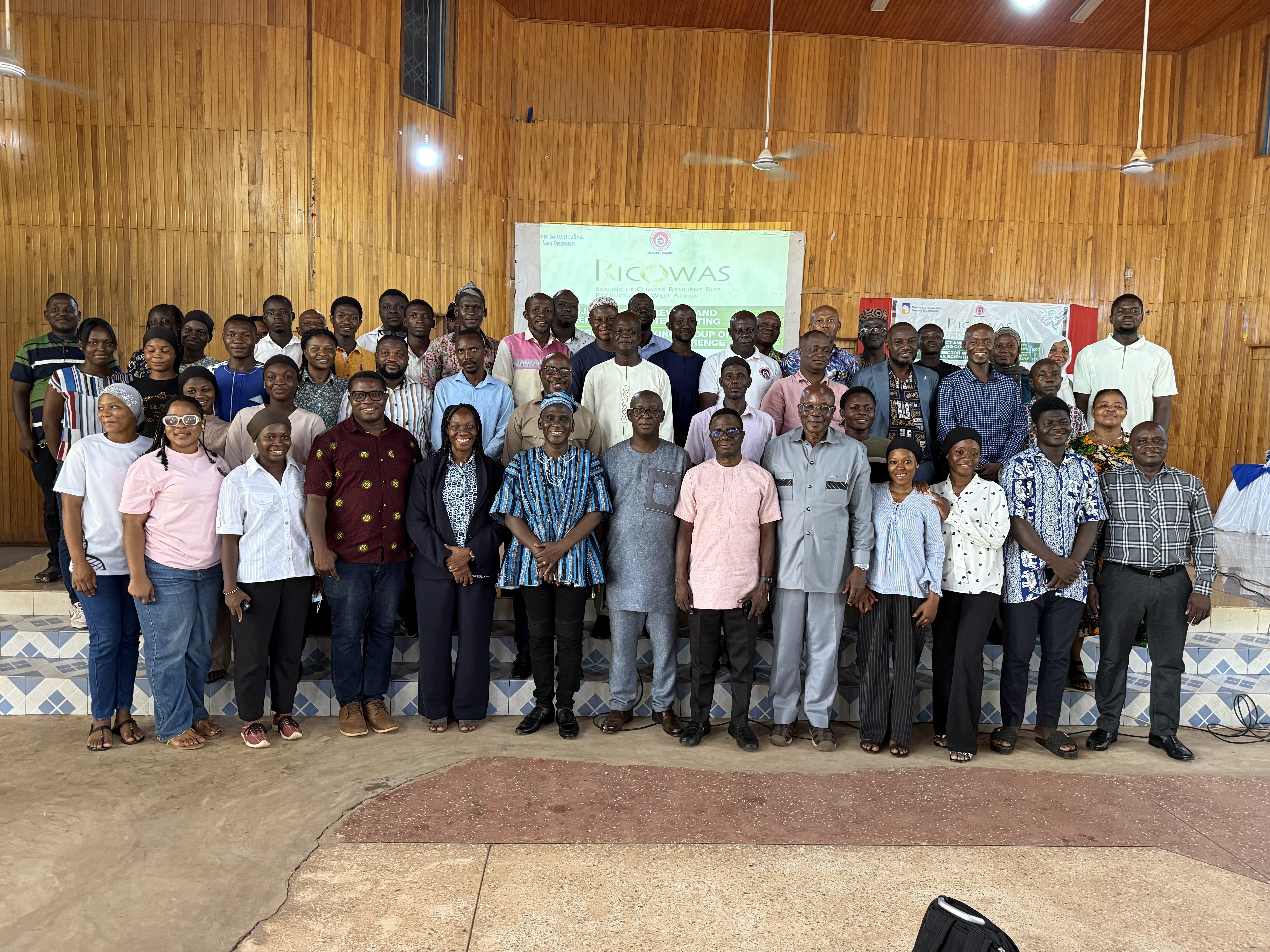
Nyankpala (N/R), June 17 – The Council for Scientific and Industrial Research - Savanna Agricultural Research Institute (CSIR-SARI) has hosted the annual review meeting and project steering committee session for the Scaling up Climate-Resilient Rice Production in West Africa (RICOWAS) project at its headquarters in Nyankpala near Tamale.
The high-level meeting brought together project implementers, researchers, regional zone coordinators, and partners to review achievements from 2025, assess challenges, and outline strategic implementation measures for the 2026 project year. The four-year initiative, supported by the Adaptation Fund through the Sahara and Sahel Observatory, is being implemented across 13 West African countries to improve the climate resilience of smallholder rice systems by promoting the System of Rice Intensification (SRI) and other climate-smart practices.
The event was attended by prominent dignitaries, including Dr. Mathias Fosu, the CSIR-SARI Board Chairman, and Dr. Francis Kusi, the Director of CSIR-SARI, who delivered the welcome address. The national project management team was led by the National Coordinator, Dr. Issah Sugri, with technical support from Mr. Alex Yeboah, the Northern Zone Coordinator and the Acting Head of the CSIR-SARI Rice Section, and Dr. Stephen Yeboah from the CSIR-Crops Research Institute (CRI) and the Southern Zone Coordinator.
Dr. Francis Kusi, the Director of CSIR-SARI, expressed the institute's continuous commitment to impactful research, noting that the results from the project's interventions across the country had been highly encouraging.
"As an institute, our mandate is to develop and transfer technologies that directly address the vulnerabilities of our agricultural sector. The RICOWAS project represents a critical pillar in our regional strategy to build a climate-resilient economy, and CSIR-SARI will continue to provide the necessary institutional and scientific backing to ensure these sustainable models are scaled up across all ecological zones to increase domestic rice production, reduce food inflation, and enhance national food security," Dr. Kusi stated.
In Ghana, the project spans 22 districts across seven regions, including the Northern, Upper East, Oti, Volta, and Bono East regions, with the ultimate target of scaling up SRI practices to benefit 13,173 rice farmers. National Coordinator Dr. Issah Sugri revealed that significant progress has already been achieved nationwide, directly increasing rice production and strengthening food security.
"We are seeing highly encouraging data from our field implementations. More than 3,700 rice farmers have already been trained under the project, while 84 demonstration fields have been established across the country," Dr. Sugri noted. "Furthermore, we have successfully trained two national master trainers and 50 master trainers, who are expected to transfer these SRI and Climate-Resilient Rice Production technologies to an additional 5,000 farmers. While significant progress has been achieved, challenges relating to mechanization, access to equipment, and the scaling up of technologies remain key concerns that require our immediate attention."
The review session continued with detailed regional field reports to capture localized progress. Mr. Alex Yeboah presented the Northern Zone progress report, revealing that the initiative has reached more than 30 communities across six districts since inception, training about 1,380 farmers on SRI technologies. He added that 12 field days had been organized, drawing more than 1,150 participants, while strategic partnerships have been established with private sector actors to support mechanization and technology dissemination.
Mr. Alex Yeboah underscored that the SRI cultivation method, which involves utilizing younger seedlings, improved water management, compost application, and optimal plant spacing, has proven highly effective at optimizing resource use, reducing water consumption, and increasing farm-level productivity.
Dr. Stephen Yeboah subsequently presented the Southern Zone progress report. He stated that project activities in the southern sector had expanded significantly from four regions at inception in 2023 to five regions, covering more than 20 districts and 25 communities. Over 2,400 farmers have been actively engaged under the project in the zone, with women making up more than half of the participants.
"The cumulative impact of the project from 2023 to 2025 shows massive improvements in farmer participation, technology adoption, and rice productivity across our communities," Dr. Stephen Yeboah explained. He detailed that interventions in the zone have focused heavily on promoting SRI technologies, distributing improved rice seed, conducting participatory variety selection activities, and strengthening farmers’ overall knowledge of climate-smart agricultural practices.
The morning sessions also featured regional updates from Mr. Yemyolya for the Savanna Zone and Dr. Salim Lamini for the Upper East Zone, followed by a joint technical presentation on Monitoring and Evaluation (M&E) frameworks and capacity need assessments led by Dr. Fati Aruna Akoriko and Dr. Joyce A. S. Haleegoah.
The review forum concluded with an afternoon Project Steering Committee meeting presided over by the Chairman, where the Project Management Unit (PMU) coordinated a synthesis of the zone reports to formalize strategic action points for the upcoming 2026 implementation year.